Showing posts with label First World War. Show all posts

Thursday, April 6, 2017

REMEMBERING the fallen on 100th anniversary of the U.S. entering The First World War ...


After nearly three years of horrific, industrialized war raging across Europe… On April 6, 1917, two days after the U.S. Senate votes 82 to 6 to declare war against Germany, the U.S. House of Representatives endorses the decision by a vote of 373 to 50 the United States Entered the War to end all Wars…


In February 1917, Germany, determined to win its war of attrition against the Allies, resumed its policy of unrestricted submarine warfare in war-zone waters. Three days later, the United States broke diplomatic relations with Germany; the same day, the American liner Housatonic was sunk by a German U-boat. On February 22, Congress passed a $250 million arms-appropriations bill intended to ready the United States for war. In late March, Germany sank four more U.S. merchant ships, and on April 2, President Wilson went before Congress to deliver his famous war message. Within four days, both houses of Congress had voted in favor of a declaration of war.


No one could have foreseen the savagery unleashed by the world’s first industrialized war, where the efficiency of modern killing machines surpassed anything imagined in past European conflicts. On the battlefield, 19th-century tactics soon proved useless against 20th-century weapons. Terrorizing the ground, machine guns had a firepower that equaled 80 rifles. Advances in artillery rained down explosives on soldiers in the trenches. Armored cars and tanks first rolled their way into battle in World War I. Chemical warfare, in the form of chlorine, mustard gas, and phosgene, poisoned hundreds of thousands of soldiers.


The Germans attacked Verdun in late February 1916, and for eight interminable, inhumane months, the siege dragged on. Always intent on perfecting its chemical warfare techniques, Germany had lobbed phosgene gas at the Allies during the siege; once in the lungs, the deadly compound turned to hydrochloric acid, burning men from the inside.

Meanwhile, the British had developed their own new weapon—the tank. And in early summer, during their tragic and misbegotten Somme offensive, tanks rolled onto the battlefield for the first time—to little avail. It took the British and French until November to advance seven miles along the northwestern front, and it cost them more than 620,000 casualties. By the time the French finally broke through at Verdun a month later, they had suffered close to 400,000 casualties and the Germans 350,000.

The Battle of the Somme revealed the horrific nature of modern warfare: immovable trenches, heavy artillery, and massive casualties. The United States was unprepared for the kind of war that its allies had been fighting for nearly three years.


July 1, 1916, west of the Somme River, northern France: In the dawn light, British and French artillery opened up, firing nearly a quarter million shells on the enemy’s entrenched positions—the final barrage before the “Big Push.” At 7:30, the first Allied officers, the great majority British Expeditionary Force, led their men out of the trenches and “over the top.” After eight days of bombarding German forward positions, they expected to advance across no-man’s-land virtually unopposed, so they were surprised to see German barbed wire still in place. Still, they kept moving forward. Then, a hundred yards from the enemy line, they were mowed down by the Germans, whose deep concrete bunkers and machine guns had remained virtually unscathed. The day remains the single bloodiest in the history of the British Army: almost 60,000 men killed or wounded, many officers in the first hour. The battle continued for another 140 days along a 15-mile front and claimed some 1.3 million casualties.


Hervey Allen, a junior infantry officer serving on the western front later wrote. Before the year was out, some two million of these brave American soldiers would be fighting in the United States’ first major international war—to its bloody end.


The Protocol for the Prohibition of the Use in War of Asphyxiating, Poisonous or other Gases, and of Bacteriological Methods of Warfare, usually called the Geneva Protocol, is a treaty prohibiting the use of chemical and biological weapons in international armed conflicts. It was signed at Geneva on 17 June 1925.


The Chemical Weapons Convention (CWC) is an arms control treaty which outlaws the production, stockpiling, and use of chemical weapons and their precursors.


There was a reason why gas attacks were banned so long ago...

The brutality of this war on mankind was supposed to be the war to end all wars...

Never forget what mankind has already gone through...


We can all do better...


Don't give up on #PeaceforallMankind ...


Wednesday, February 1, 2017

Germany prepared to attack any and all ships, including civilian passenger carriers


The story of A Century of November takes place in a time where Germany prepared to attack any and all ships, including civilian passenger carriers, said to be sighted in war-zone waters.


This was one of the components that pushed the United States of America to call for a declaration of war against Germany.

On this day 100 years ago…

Germany resumes unrestricted submarine warfare…


This began in part with pressure from neutral countries and out of fear the U.S. would enter the war on the side of the Allies.

When World War I erupted in 1914, President Woodrow Wilson pledged neutrality for the United States, a position that the vast majority of Americans favored. Britain, however, was one of America’s closest trading partners and tension soon arose between the United States and Germany over the latter’s attempted blockade of the British isles. Several U.S. ships traveling to Britain were damaged or sunk by German mines and, in February 1915, Germany announced unrestricted warfare against all ships, neutral or otherwise, that entered the war zone around Britain. One month later, Germany announced that a German cruiser had sunk the William P. Frye, a private American merchant vessel that was transporting grain to England when it disappeared. President Wilson was outraged, but the German government apologized, calling the attack an unfortunate mistake.


The Germans’ most formidable naval weapon was the U-boat, a submarine far more sophisticated than those built by other nations at the time. The typical U-boat was 214 feet long, carried 35 men and 12 torpedoes, and could travel underwater for two hours at a time. In the first few years of World War I, the U-boats took a terrible toll on Allied shipping.


In early May 1915, several New York newspapers published a warning by the German embassy in Washington that Americans traveling on British or Allied ships in war zones did so at their own risk. The announcement was placed on the same page as an advertisement for the imminent sailing of the British-owned Lusitania ocean liner from New York to Liverpool. On May 7, the Lusitania was torpedoed without warning just off the coast of Ireland. Of the 1,959 passengers, 1,198 were killed, including 128 Americans.

The German government maintained that the Lusitania was carrying munitions, but the U.S. demanded reparations and an end to German attacks on unarmed passenger and merchant ships. In August 1915, Germany pledged to see to the safety of passengers before sinking unarmed vessels, but in November sank an Italian liner without warning, killing 272 people, including 27 Americans. Public opinion in the United States began to turn irrevocably against Germany.


At the end of January 1917, Germany, determined to win its war of attrition against the Allies, announced the resumption of unrestricted warfare. Three days later, the United States broke off diplomatic relations with Germany; just hours after that, the American liner Housatonic was sunk by a German U-boat. None of the 25 Americans on board were killed and they were picked up later by a British steamer.


On February 22, Congress passed a $250 million arms-appropriations bill intended to ready the United States for war. Two days later, British authorities gave the U.S. ambassador to Britain a copy of what has become known as the “Zimmermann Note,” a coded message from German Foreign Secretary Arthur Zimmermann to Count Johann von Bernstorff, the German ambassador to Mexico. In the telegram, intercepted and deciphered by British intelligence, Zimmermann stated that, in the event of war with the United States, Mexico should be asked to enter the conflict as a German ally. In return, Germany would promise to restore to Mexico the lost territories of Texas, New Mexico and Arizona. On March 1, the U.S. State Department published the note and America was galvanized against Germany once and for all.


In late March, Germany sank four more U.S. merchant ships and, on April 2, President Wilson appeared before Congress and called for a declaration of war against Germany. On April 4, the Senate voted 82 to six to declare war against Germany. Two days later, the House of Representatives endorsed the declaration by a vote of 373 to 50 and America formally entered World War I.

By 2013 41 sunken German World War One U-boats were discovered off the coast of England. They were found at a depth of about 50 feet (15.24 meters).


History is part of our lives… We need to remember, always… Who we are and where we have come from…

Because on a global scale so many human beings have sacrificed their lives fighting conflict after conflict…
so that we may live…

100 years later… after the end of THE GREAT WAR… The war that was suppose to end all wars...

PEACE FOR ALL MANKIND!

Tuesday, February 2, 2016

A Century of November Jay Wolpert Interview Part 3


This is part 3 of a nearly one-hour uncut interview recorded with one of the people responsible for helping to create one of the most successful and largest Film Franchises in Hollywood History.


He is also credited for the screenplay adaptation of a novel that maintains an iconic stature.

He is the very talented and charismatic screenwriter Jay Wolpert of Pirates of the Caribbean and The Count of Monte Cristo.


Jay shares his thoughts on his early career as a game show producer for the Price is Right, his second career as a screenwriter, Nancy Meyers, life in Hollywood, film genres, war and politics and the tragedy associated with them.


Along with his knowledge and experience about the source material from script to screen, the strength that bonds a father and son and how far would a parent travel and sacrifice to endure the love of a child and family, on the development of a feature film project entitled A Century of November.

https://www.youtube.com/watch?v=-0s2O3-vxSk

Thursday, January 21, 2016

A Century of November Jay Wolpert Interview Part 2

This is part 2 of a nearly one-hour uncut interview recorded with one of the people responsible for helping to create one of the most successful and largest Film Franchises in Hollywood History.

Jay is also credited for the screenplay adaptation of a novel that maintains iconic stature.

He is the very talented and charismatic screenwriter Jay Wolpert of Pirates of the Caribbean and The Count of Monte Cristo.

Jay shares his thoughts on his early career as a game show producer, life in Hollywood, story and characters on Gone with the Wind and Casablanca.

The source material from script to screen, the strength that bonds a father and son and how far would a parent travel and sacrifice to endure the love of a child and family, on the development of a feature film project entitled A Century of November.

https://www.youtube.com/watch?v=h7q_a-V_y8E


Friday, January 8, 2016

Journey of a Lifetime Part 2

To look forward is to always remember where we have come from and how we came to be where we are today.

Reflecting on this Journey of a Lifetime;

In addition to a completed Oscar caliber Script from Jay Wolpert, a 5 min short film was shot based on the story recreating moments of The Great War.


A very well thought out, aggressive shot list was put together and over the course of 7 months Richard Schmon was hired by Pacific Empire Corporation to document a part of the Journey of a Lifetime, to shoot stills and time-lapse video for A Century of November short film.

Producer Nicolas Awde.

A Century of November is based on the acclaimed novel by award winning American Author W.D. Wetherell with a screenplay adaptation by Hollywood Screenwriter Jay Wolpert (Pirates of the Caribbean / The Count of Monte Cristo).


Cinematographer Joel Ransom watching the monitors at video village.

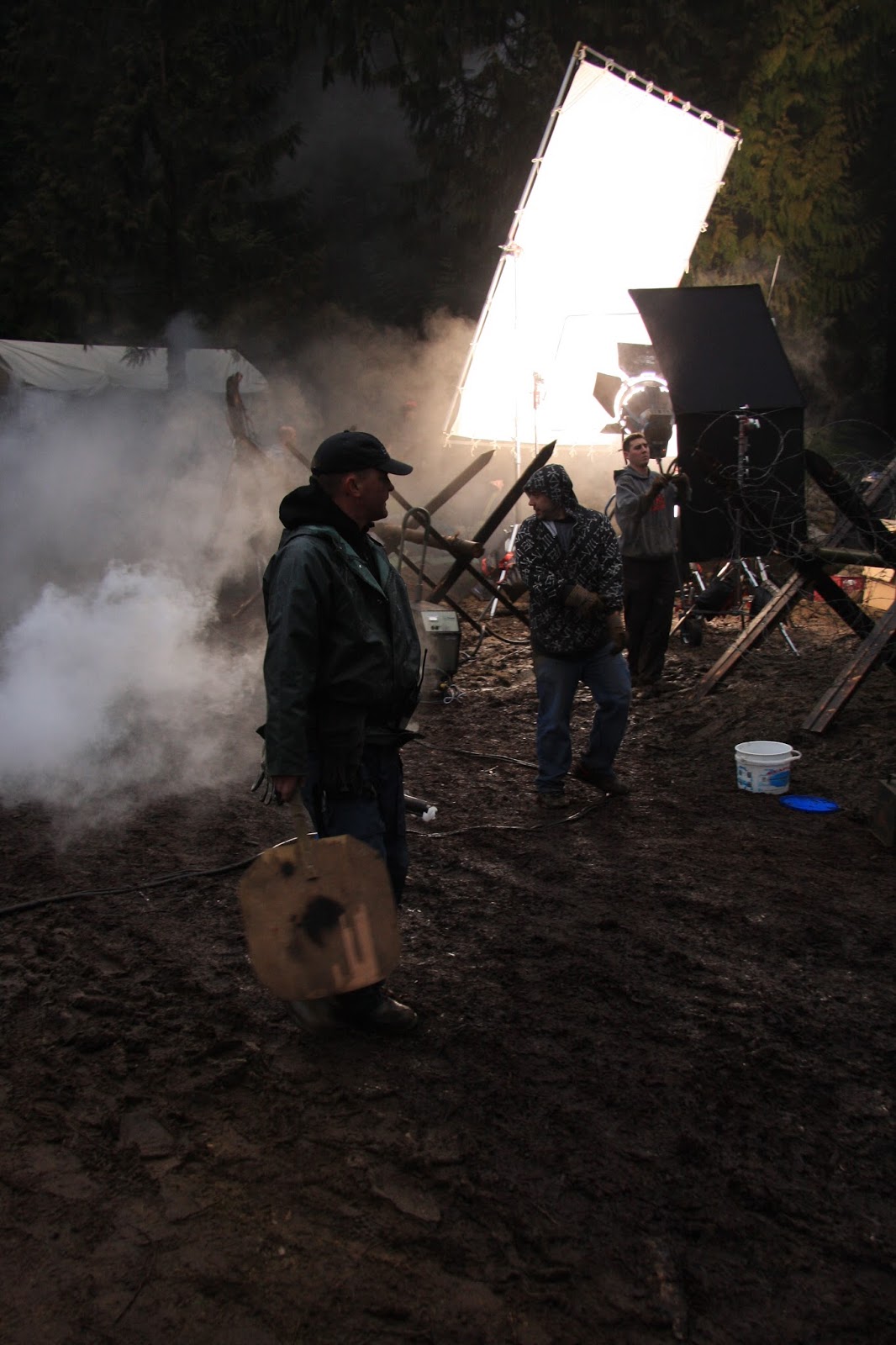
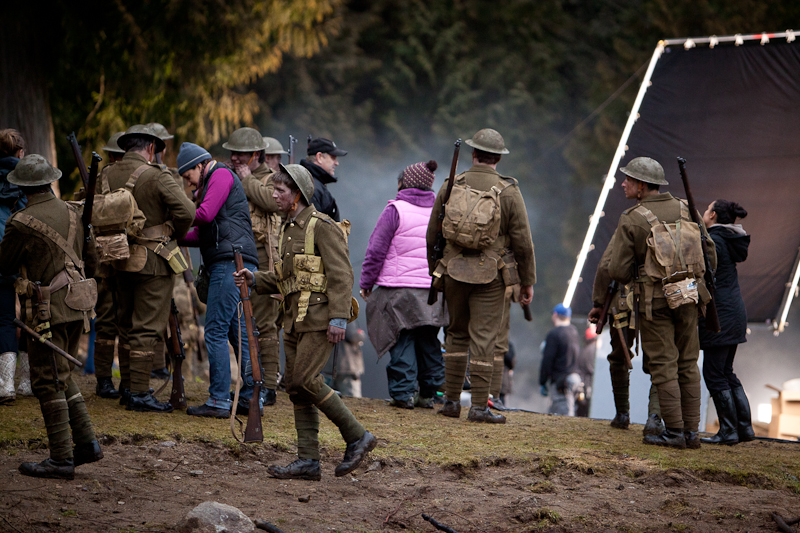
On a Saturday that produced some of the most undesirable conditions for human beings (really cold, overcast, wet, muddy and raining) (perfect conditions for recreating the First World War), over 100 cast and crew began at 6:00am and an average of 300 people gathered throughout the day in Mission, BC to shoot a promotional teaser for A Century of November. With cinematographer Joel Ransom behind the camera, everybody forged through a blustery wet day in the mud.


Many other key department heads included First Assistant Director Jack Hardy (RIP), Oscar Nominated Production Designer Peter Lando, Oscar Nominated Costume Designer Monique Prudhomme, Visual Effects Supervisor John Gajdecki, Key Grip Tony Whiteside, Stunt Coordinator JJ Makaro, and Props Master Jimmy Chow.


The promotional teaser was captured with a combination of Panavision Genesis cameras as well as Arriflex 435 film cameras and Kodak's 5219 Vision 3 film stock, all with Panavision's gorgeous glass. The camera crew also had the epic 50 foot Super Technocrane with the Mega 3 three axis remote head at their disposal.


The 11:1 Primo Zoom. An optical marvel. 24-275mm at a fixed T2.8.

The set at “Westwood” in Mission B.C. was divided into two halves, the first being the elaborate trench set and the second being "No Man's Land", the lethal bombed out space separating enemy and friendly lines on the western front. These were constructed one piece at a time over the course of the last seven months.


As the local coniferous trees and foliage do not accurately match those found in France and Belgium, both blue and green screens were employed to enable the Visual Effects team to composite the war torn backgrounds of the era.

Below are some of my images and time lapse from the set. Over the course of 12 hours Richard Schmon captured over 600 raw files and my three time-lapse cameras shot more than 35,000 jpegs!

Again, there are some moments from their story that help illustrate that nothing’s impossible: respectful persistence, drive, determination, heart, passion and a never give up attitude is everything.

They have recognized their opportunity.

A Century of November... Imagine… 

Development endures to the next stage…


A Journey of a Lifetime continues…